THE ARTIST BEHIND THE DESIGNS: EMMA WHITFIELD
Meet Emma Whitfield, the artist behind our hemp clothing designs. In this interview, Emma discusses art, peace, rebellion and the power of an image—from the symbols that inspire her to the work of bringing an idea to life.
Add Your Heading Text Here

“You’re making something that didn’t exist before.”
When you begin a new design, where does the idea come from? How do you decide what you’re going to make?
I’ve always been very interested in the idea of the popular image — why certain photographs, graphics, posters or symbols somehow enter the public consciousness.
Even as a child, I noticed that. You’d see particular posters or images appearing everywhere and I’d wonder what it was about that image that made people connect with it.
That’s probably at the heart of a lot of what I do. I’m interested in images that people already understand on some level, but then I want to take them somewhere else — change them, combine them with something or give them another meaning.
I’m also very interested in peace and harmony, and in the opposite of that: conflict.
And conflict doesn’t only mean one country going to war with another. There are all kinds of wars. There are wars between people, political struggles and even, in a sense, the war we’re waging on the earth itself.
Those ideas inevitably find their way into the work.
How do you actually create the postcard designs?
They begin with an idea rather than simply deciding that I want to make a nice-looking image.
I’ll find a photograph, symbol or piece of imagery that interests me and then work with it — simplifying it, changing it and introducing other elements until it becomes something of my own.
That’s part of what interests me about graphic art. A relatively simple image can contain quite a lot once you start looking at what the different elements represent.
Sometimes adding something as simple as the colours of a flag can completely change the meaning of an image.
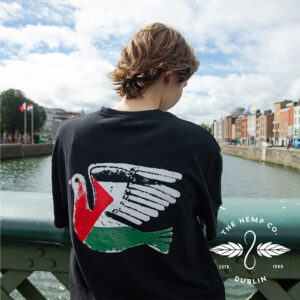
Is that what happened with the Palestine Dove?
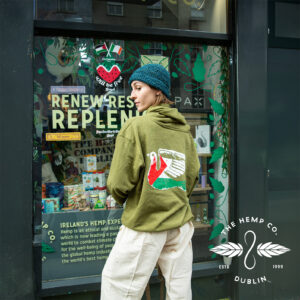
Yes. I was researching symbols of peace and became interested in the dove, which has represented peace for thousands of years. The particular form I worked from was inspired by an ancient Greek design.
I then incorporated the colours and imagery of the Palestinian flag into the dove.
I didn’t want to simply reproduce the flag or make another image people had already seen many times. I wanted the Palestinian identity to become part of a symbol that people already instinctively associate with peace.
Of all the designs, I think that one is probably the most evolved in terms of both the design itself and the symbolism behind it.
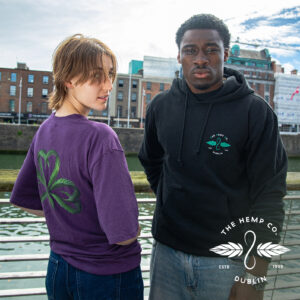
There’s an Irish peace-sign design as well. Was that coming from the same idea?
Very much so.
The two-finger peace sign is one of those gestures that almost doesn’t require language. People see it and immediately understand what it means.
I liked taking that universal symbol and introducing the Irish flag into it.
It’s a very simple intervention, but suddenly the image says something slightly different. That’s what interests me — taking something familiar and changing the context around it.
Where did this fascination with iconic images come from?
My father definitely had an influence on that.
He worked with typefaces before computers, when lettering and typography were physically created by hand. He would sometimes point at lettering on a lorry or something out in the world and say, “I designed that typeface.”
As a child, I found that extraordinary.
Somebody could sit somewhere and make something with their own hands, and then that thing could leave them and become part of the visual world that thousands of other people experienced.
I also remember that famous 1970s tennis-girl poster being absolutely everywhere when I was young.
Even then I was fascinated by it — not necessarily because of the subject itself, but because of the power that one image had acquired. Why that photograph? Why did everybody want it?
What makes one image disappear and another become iconic?
I’ve never really stopped being interested in that question.
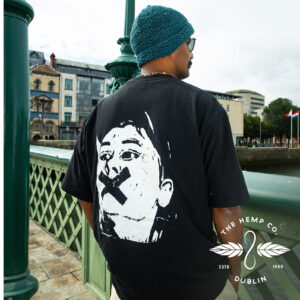
And that connects to the Kneecap design?
Absolutely.
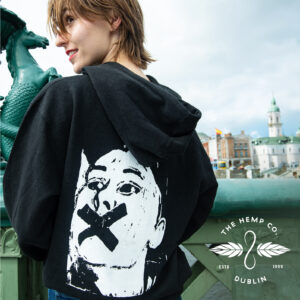
What interested me there was the image of somebody being silenced — someone literally having their mouth covered and being told they aren’t allowed to speak.
You almost don’t need to explain that image. People understand it immediately.
There’s also a long tradition in art of taking photographs from newspapers, politics or popular culture and turning them into something else.
Andy Warhol did it constantly. An image might begin as a photograph associated with a particular moment, but once an artist intervenes it can take on another life entirely.
That’s what interested me about the Kneecap image. It isn’t only about the photograph itself. It’s about what the image of being silenced represents.
Would you like one of your images to become iconic in that way?
I’d love that.
The Che Guevara photograph is probably the ultimate example. It began as a photograph of a particular person at a particular moment and became one of the most recognisable political images in the world.
At some point it almost transcended the original photograph.
I’ve also made an image of Sinéad O’Connor that people responded to very strongly, and I’d love to explore that further.
Certain people and certain moments have something about them that can be distilled into a very powerful image.
You grew up around art as well, didn’t you?
Completely.
My mother, Catherine, was an artist, so there was art everywhere in our house. She loved art, music and poetry, and creativity was simply part of everyday life.
The funny thing is that when you’re a child you don’t realise there’s anything unusual about the environment you’re growing up in.
I assumed everybody lived like that.
Between my mother and my father’s work with typography and design, I was surrounded by people who made things.
That undoubtedly shaped how I see the world.
What inspires you now?
It’s very difficult for me to separate inspiration from the actual work of being an artist.
Of course I’m inspired by other artists, by politics, people, music, popular culture and things happening in the world.
But there’s another side of creativity that people don’t always see.
There’s an idea associated with the Cheshire Cat in Alice in Wonderland: everybody notices the smile, but behind that smile there’s an entire cat.
Art is a little like that.
People see the finished painting, the song, the photograph, the performance — the smile — but they don’t necessarily see everything that had to exist behind it.
The hours. The mistakes. The thinking. The years spent learning how to do it.
Talent on its own isn’t enough.
You have to do the work.
Is that something you’ve learned as you’ve got older?
Definitely.
I admire someone like David Hockney enormously for that reason. And although I don’t necessarily love every Francis Bacon painting, I’ve always been fascinated by his personality and his absolute commitment to being an artist.
At some point you have to decide that the time you spend painting, drawing, writing, dancing or making music has value.
Other people might not always recognise it as work.
But it is work.
In fact, you’re an artist 24 hours a day because your mind doesn’t really switch it off. You’re constantly noticing things, making connections and thinking about what something could become.
You described creating art as being almost like magic.
I think it is.
You’re making something that didn’t exist before.
There was nothing there, and then through your imagination and your hands you’ve brought something into the world.
That’s a strange and wonderful thing when you really think about it.
In that sense, an artist is a little like a magician.
But you also have to be strong to keep doing it. You probably need a rebellious streak because you’re deciding that this thing matters even when the world might be telling you to spend your time doing something more conventional.
If you have that ability, I think you should use it.
There were plenty of years when I didn’t use mine enough.
Now I feel as though the tide has turned.
Was there a moment when you started taking yourself more seriously as an artist?
Someone once said something to me that really stayed with me.
They told me that when I went somewhere, I should go there “in my capacity as an artist.”
It sounds like such a small distinction, but it changed something in my head.
You stop saying, “I sometimes make art,” and start saying, “I’m an artist.”
Once you accept that identity yourself, you start protecting the time it requires and giving the work the importance it deserves.
I’ve raised children as a single woman while trying to continue creating, so naturally there have been periods when other things had to come first.
But eventually you have to reclaim that part of yourself.
What would you ultimately like somebody to get from your work?
I’d like them to feel something.
It doesn’t necessarily have to be some enormous intellectual reaction.
Someone once bought one of my small paintings and later told me that she looked at it every morning and it made her smile.
I thought that was wonderful.
You’ve made something in one place, somebody else has taken it into their home, and now this little thing you’ve created gives them a moment of happiness every day.
What more could you really ask from a piece of art?
There also seems to be a rebelliousness running through your work — not just politically, but towards how we’re expected to live.
Yes, because I’m suspicious of the idea that we’re supposed to define ourselves by what we own.
We’re constantly encouraged to buy things and accumulate things and somehow believe that these things will tell us who we are.
I’ve even been playing around with lyrics recently about being fed up, selling your soul for a sofa and becoming boring for a kitchen island!
It’s funny, but there’s something serious underneath it.
Surely life has to be about more than accumulating possessions.
Art, music, ideas, family, politics, community, the people around you — those are the things that actually make a life interesting.
Maybe making art is partly a rebellion against the alternative.
It’s saying: I’m going to make something. I’m going to care about something. I’m going to put something into the world rather than simply consume what’s already there.